
Originally published July 12, 2023 • Updated June 18, 2026
In 20 Seconds: What You Need to Know About Web-to-Print
- Web-to-print is eCommerce built for print. It’s a cloud-hosted software platform that lets your customers browse catalogs, customize products, proof designs, place orders, and track jobs online – through a branded storefront that looks and feels like yours.
- It’s not optional anymore. In 2026, B2B buyers expect the same digital convenience they get from consumer platforms. Print shops that still rely on email, phone calls, and spreadsheets to manage orders are losing business to competitors who’ve gone online.
- The real value goes far beyond ordering. A modern web-to-print platform automates approval workflows, enforces brand compliance, integrates with your MIS and ERP systems, connects to enterprise procurement platforms via cXML, and provides reporting that helps you make smarter business decisions.
- Choosing the right partner matters. The technology is only part of the equation. A proven implementation process, a team of print industry experts, and a plan for driving user adoption are what determine whether your investment pays off.
Why Web-to-Print Exists: The Industry Forces That Created It
Web-to-print didn’t emerge in a vacuum. It was born from a set of industry pressures that have only intensified over the past decade – and that continue to define the business reality for every print operation in 2026.
Smaller Job Sizes, Higher Volume
The era of the 10,000-piece print run as the bread-and-butter order is over. Digital printing technology has made it economical for customers to order 50 business cards, 200 brochures, or 25 personalized event programs. While that flexibility is great for buyers, it creates a fundamental challenge for print shops: each individual job generates less revenue, which means you need to process significantly more jobs to maintain profitability. The only way to do that without proportionally increasing your staff is automation – and that starts with how orders enter your system.
Rising Production Costs
Paper, ink, energy, labor, freight – costs across the board have risen. Margins in print were already thin; in 2026, they’re razor-thin. Every manual touchpoint in your workflow – every phone call to clarify an order, every email to chase down artwork, every re-entry of job specs into your MIS – represents a cost that erodes your margin. Web-to-print eliminates those touchpoints.
B2B Buyers Expect Consumer-Grade Experiences
Your customers don’t compare your ordering process to other print shops. They compare it to Amazon. They expect to browse a product catalog, customize what they need, see pricing in real time, check out in a few clicks, and track their order to delivery. If your “ordering process” is an email with a PDF attachment or a phone call, you’re not meeting the bar.
Enterprise Clients Require System Integration
The most valuable print accounts – Fortune 500 companies, universities, hospital systems, government agencies – buy through centralized procurement platforms. They require their print vendors to integrate via cXML PunchOut, support single sign-on (SSO), and connect to their existing business systems. A print shop without these capabilities is simply invisible to these accounts.
What Web-to-Print Actually Is
At its core, web-to-print is a cloud-hosted SaaS (Software as a Service) eCommerce platform purpose-built for the print industry. It provides your customers with a branded online storefront where they can:
- Browse a curated product catalog tailored to their organization
- Customize templates with their own names, logos, locations, images, and variable data
- Proof and approve designs before they go to production
- Place orders with real-time pricing and shipping options
- Track jobs from order to delivery
- Reorder from their order history with a few clicks
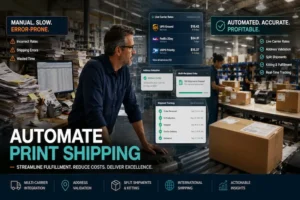
But web-to-print is more than a storefront. It’s the automation engine that connects your customer’s ordering experience to your back-end production workflows. When an order is placed, the platform can automatically route the job to your MIS, generate production-ready files, trigger approval workflows, calculate shipping, and update the customer on job status – all without manual intervention.
Common Misconception: “Our Orders Are Too Custom for Online Ordering”
This is one of the most persistent myths in the industry. In reality, the vast majority of print orders – even highly customized ones – can be streamlined through a well-configured web-to-print portal. The key is choosing a platform designed for print complexity, not a generic eCommerce tool. Features like locked templates, variable data personalization, content libraries, configurable approval chains, and bulk ordering handle the complexity that generic platforms can’t.
Who Uses Web-to-Print?
Web-to-print serves three primary audiences, each with distinct needs:
Commercial Printers
Print businesses that sell to external customers. Web-to-print gives your clients a branded, self-service ordering portal that reduces manual touchpoints and increases order volume. PageDNA’s multi-tenant architecture lets you manage hundreds of client storefronts from a single platform, each with its own products, pricing, branding, and approval rules.
Internal Print Shops (In-Plants)
In-house print operations within universities, hospitals, government agencies, and corporations. Web-to-print transforms your print shop from a cost center into a strategic asset by streamlining ordering, enforcing brand compliance, managing budgets, and generating reports that demonstrate value to your parent organization.
Brand Owners and Marketing Procurement Teams
Marketing and brand teams at multi-location organizations who need to control print spending, maintain brand consistency, and empower local teams to order approved materials. Web-to-print’s locked templates and division-based storefronts ensure materials are always on-brand, on-time, and on-budget.
The Core Capabilities of a Modern Web-to-Print Platform
Not all web-to-print platforms are created equal. Here’s what to look for in 2026.
Capability | What It Does | Why It Matters |
Branded Storefronts | Each client gets a private, branded online catalog with their own products, pricing, and branding | Customers feel like they’re ordering from their own system, not a third-party vendor |
Template Personalization | Users customize locked templates with variable data – names, titles, locations, images – while design integrity stays protected | Enables self-service ordering for complex products without compromising brand standards |
Approval Workflows | Configurable multi-level approvals route orders to the right people before production | Ensures brand compliance, budget control, and accountability |
Real-Time Shipping | Live carrier rates from UPS, FedEx, and other carriers displayed at checkout | Eliminates guesswork and builds trust with accurate, transparent pricing |
Bulk Ordering | Upload a spreadsheet to generate hundreds of unique, personalized orders at once (learn more) | Solves franchise rollouts, HR onboarding, and multi-location distribution at scale |
Inventory Management | Track physical inventory, set reorder alerts, and sync with external systems | Prevents overselling and ensures fulfillment accuracy |
MIS/ERP Integration | Bi-directional data flow with your print MIS and production systems | Eliminates manual re-entry, accelerates production, and enables real-time status updates |
cXML/eProcurement | Round-trip PunchOut integration with SAP Ariba, Coupa, Jaggaer, and more | Opens the door to enterprise accounts that require procurement system integration |
SSO (Single Sign-On) | SAML2-based authentication with Azure, Okta, ADFS, Shibboleth | Simplifies user management and strengthens security for enterprise clients |
Reporting and Analytics | Comprehensive reporting on orders, users, budgets, and trends | Provides the data you need to make informed business decisions |
API-First Architecture | A robust API with support for webhooks and headless commerce | Future-proofs your platform and enables custom integrations |
How Web-to-Print Connects to the Broader Business Ecosystem
One of the most important shifts in web-to-print over the past few years is the move from standalone storefront to connected platform. In 2026, your web-to-print system isn’t an island – it’s a hub that connects to every other system your business (and your customers’ businesses) rely on.
Production Systems (MIS/ERP)
When an order is placed, the platform automatically submits the job to your MIS with all production specs, artwork, and shipping details. When the job status changes in your MIS, the platform notifies the customer. Inventory levels stay synchronized. This bi-directional flow eliminates the manual re-keying that wastes time and introduces errors.
Procurement Platforms
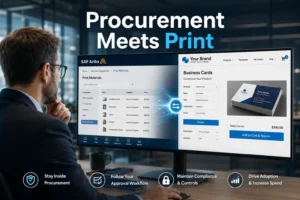
Enterprise clients buy through procurement systems like SAP Ariba, Coupa, and Jaggaer. PageDNA’s cXML PunchOut capability lets buyers seamlessly navigate from their procurement portal into your storefront, configure customized products, and return a structured cart for approval – all without leaving their purchasing workflow. This capability is increasingly a hard requirement for winning enterprise contracts.
Shipping Carriers
Direct API integrations with UPS, FedEx, and other carriers provide real-time rate calculation, address validation, and automated tracking notifications. Customers see exact shipping costs before they check out, and they get proactive updates as their orders move through fulfillment.
Identity Providers (SSO)
Single sign-on integration with Azure AD, Okta, ADFS, and Shibboleth means users can access their print storefront with their existing corporate credentials. No separate login to remember, no separate password to manage. This is table stakes for enterprise deployments.
Warehouse and Fulfillment Systems
For operations that include kitting, inventory, and third-party fulfillment, web-to-print can integrate with warehouse management systems (WMS) like Direct Response to coordinate pick-and-pack, shipping, and inventory synchronization.
The Business Impact: What Web-to-Print Delivers
Before Web-to-Print | After Web-to-Print |
Orders arrive via email, phone, and walk-ins – each requiring manual processing | Orders enter the system pre-validated, production-ready, and automatically routed |
Artwork errors caught late in production, leading to costly reprints | Customers proof and approve online before submission, reducing errors dramatically |
Shipping quoted manually or estimated – often inaccurately | Real-time carrier rates calculated automatically, building customer trust |
No visibility into order status – customers call or email to ask “where’s my order?” | Automated status updates and self-service order tracking eliminate support calls |
Enterprise accounts out of reach because you can’t integrate with their systems | cXML PunchOut, SSO, and API capabilities open the door to the largest accounts |
Growth limited by headcount – more orders means more staff | Automation allows you to scale volume without proportionally scaling labor |
How to Choose the Right Web-to-Print Platform
Choosing a web-to-print platform is one of the most consequential technology decisions a print operation will make. Here’s what to evaluate (see also: how to pick the right platform):
Is it built for print? Generic eCommerce tools – WordPress plugins, Shopify add-ons – don’t understand prepress, variable data, production-ready file output, or split shipments. Choose a platform built by print professionals for print professionals.
Does it come with a proven process? Technology alone doesn’t drive results. Look for a vendor with a documented implementation methodology that includes product configuration, workflow design, user training, and a plan for adoption – not just a login and a knowledge base.
Can it integrate with your systems? Your MIS, your shipping carriers, your customers’ procurement platforms, their SSO providers. A platform that can’t connect to these systems is a silo, not a solution. Look for a robust API and established integration partnerships.
Who supports it? When something goes wrong at 2pm on a Tuesday, who answers? Look for a US-based team of print industry experts – not a generic support queue. PageDNA’s team has an average response time of 1.2 hours. Check what customers say on SourceForge and Capterra.
Will it grow with you? Can the platform handle multi-tenant storefronts? Enterprise-grade security? Bulk ordering at scale? The platform you choose today needs to support the business you’re building for tomorrow.
Key Takeaways
- Web-to-print is a cloud-hosted eCommerce platform purpose-built for print operations. It enables online ordering, template personalization, approval workflows, and deep integration with production and business systems.
- In 2026, web-to-print is not optional. B2B buyers expect digital convenience, enterprise clients require system integration, and shrinking margins demand automation.
- The most impactful web-to-print implementations go beyond the storefront – they connect ordering to production, shipping, procurement, and reporting in a unified, automated workflow.
- Choosing the right platform means evaluating not just features, but the implementation process, support quality, integration capabilities, and long-term scalability.
Frequently Asked Questions (FAQs)
How long does it take to launch a web-to-print storefront?
With a structured implementation process like PageDNA’s, most customers launch their first storefront in 49-69 days. The process requires approximately one hour of your time per week, with the implementation team handling the heavy lifting.
Is web-to-print only for large print shops?
Not at all. Print operations of all sizes benefit from web-to-print. Some of PageDNA’s most successful customers started small and grew with the platform. If you’re managing print orders through email and spreadsheets, you’re a candidate.
What if my customers don’t want to order online?
This is one of the most common concerns in the industry – and it almost never holds up in practice. Once customers experience the convenience of online ordering with real-time proofing, pricing, and tracking, adoption follows quickly. The key is providing a platform that’s genuinely intuitive.
Can web-to-print handle complex products like variable data, kitting, and multi-recipient distribution?
Yes. This is exactly what purpose-built web-to-print platforms are designed for. Features like variable data personalization, bulk ordering, inventory management, and multi-recipient shipping handle complexity that generic eCommerce platforms simply cannot.
How does web-to-print differ from print-on-demand?
Web-to-print is a B2B platform for managing branded print procurement across organizations – think business cards, marketing collateral, compliance materials, and corporate signage. Print-on-demand is a B2C model for selling consumer products like custom t-shirts and phone cases. The audiences, workflows, and technology requirements are fundamentally different.
Conclusion: The Foundation of a Modern Print Operation
Web-to-print is not a trend. It’s the foundational technology that modern print operations are built on. Whether you’re a commercial printer looking to grow your eCommerce presence, an internal print shop demonstrating value to your organization, or a brand owner maintaining consistency across hundreds of locations, web-to-print is how you get there.
The print shops that are thriving in 2026 aren’t just producing great print. They’re delivering exceptional digital experiences that make ordering easy, fast, and reliable. They’re automating workflows that used to consume hours of manual labor. They’re integrating with the business systems their customers already use. And they’re using data to make smarter decisions about their operations.
If you’re ready to take the next step, reach out to PageDNA at sales@PageDNA.com or schedule a demo. We’d love to help you launch, automate, and succeed.
Related Posts: