
Originally published June 26, 2023 • Updated April 6, 2026
In 20 Seconds: Why cXML Matters for Your Print Business
- cXML is the universal language of B2B procurement. Commerce eXtensible Markup Language (cXML) is the industry-standard protocol that allows your web-to-print storefront to communicate directly with your customers’ enterprise procurement systems, such as SAP Ariba, Coupa, Oracle, and more.
- PunchOut is the killer feature. A cXML PunchOut lets a buyer “punch out” from their company’s procurement portal into your branded print storefront, customize and configure products, and return a structured cart back to their system for approval and payment, all without leaving their procurement workflow.
- In 2026, cXML isn’t a niche capability; it’s a competitive requirement. Large enterprises increasingly mandate that their suppliers support PunchOut integration. If your print shop can’t integrate, you’re locked out of the most lucrative accounts. If you can, you become deeply embedded in their purchasing workflow, creating long-term loyalty and recurring revenue.
- Key Developments: The cXML standard continues to evolve, with modern integrations now supporting RESTful API layers alongside traditional cXML, headless commerce architectures, and tighter security via OAuth 2.0 and SSO. PageDNA pioneered the first-ever cXML PunchOut for print in 1999 and continues to lead in this space.
The Protocol That Connects Print to the Enterprise
If you’ve ever ordered something online – compared flights on a travel site, used your Google account to log in to a new app, or checked the weather on your phone – you’ve benefited from software systems talking to each other behind the scenes. That’s exactly what cXML does for the world of B2B procurement, and it’s one of the most important technologies a print shop can leverage in 2026.
Here’s the business reality: large organizations – Fortune 500 companies, universities, hospital systems, government agencies – don’t buy print the way a small business does. They don’t browse a website and enter a credit card. They purchase through centralized eProcurement systems (also called ERP systems) that enforce spending controls, approval workflows, and vendor management policies. If your print shop can’t connect to these systems, you simply can’t sell to these customers.
cXML is the bridge. It’s the standardized language that enables your web-to-print storefront to integrate seamlessly with your customers’ procurement platforms, creating a frictionless ordering experience that benefits everyone: the buyer gets the convenience of ordering within their approved system, and you get access to enterprise-scale accounts with predictable, recurring revenue.
This guide explains what cXML is, how PunchOut integration works, why it’s become a non-negotiable capability for competitive print shops, and what’s changed in the cXML landscape heading into 2026.
What Is cXML?
cXML stands for Commerce eXtensible Markup Language. It’s an industry-standard protocol, originally developed by Ariba (now SAP Ariba), that defines how business software communicates during procurement transactions. Think of it as a shared vocabulary that allows different systems to exchange structured information about products, pricing, orders, invoices, and shipping.
Where cXML becomes transformative for print is through a specific capability called PunchOut, which allows a buyer to seamlessly navigate from their procurement system into a supplier’s storefront and back again without any manual data re-entry.
cXML vs. EDI: Why cXML Won
Before cXML, B2B data exchange relied heavily on Electronic Data Interchange (EDI), a format that’s rigid, expensive to implement, and difficult for non-technical teams to work with. cXML offered a more flexible, human-readable alternative built on XML, the same markup language that powers much of the web. It’s easier to customize, cheaper to maintain, and far better suited to the complexity of modern procurement. Today, cXML is the dominant standard for catalog-based eProcurement.
What Is an eProcurement System?
Most large organizations use an eProcurement system, a centralized platform where employees order everything their company needs, from office supplies and IT equipment to printed materials and branded merchandise. Popular eProcurement platforms include:
- SAP Ariba – The largest procurement network in the world
- Coupa – A leading cloud procurement platform
- Oracle iProcurement – Part of the Oracle ERP ecosystem
- Jaggaer – Widely used in higher education and government
- Workday – Growing rapidly in enterprise procurement
When a buyer orders through their eProcurement system, they access a single catalog that spans every approved vendor. Instead of visiting separate websites for pens, business cards, a video projector, and installation services, they find everything in one place. Budget controls, approval workflows, and payment processing all happen within the same system.
But here’s the challenge for print: printed materials aren’t simple commodities. They require customization, like choosing paper stock, uploading artwork, personalizing variable data fields, selecting quantities and finishing options. A static line item in a procurement catalog can’t capture this complexity. That’s where PunchOut comes in.
PunchOut: How cXML Connects Print to Procurement
The cXML PunchOut is the feature that makes eProcurement integration work for print. It creates a seamless round-trip between the buyer’s procurement system and your web-to-print storefront.
How a PunchOut Works: Step by Step
- The buyer starts in their eProcurement system. They browse the company catalog and find the print category (e.g., “Marketing Materials” or “Business Cards”).
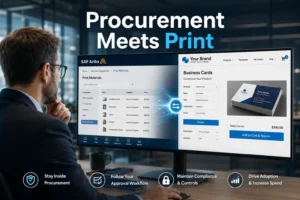
- The system “punches out” to your storefront. The buyer is seamlessly redirected from their procurement portal to your branded PageDNA storefront – no separate login required. Their identity and session data are securely passed via cXML.
- The buyer shops, customizes, and configures. This is where the magic happens. The buyer can browse your full product catalog, customize templates with variable data, upload artwork, select quantities and finishing options, and preview proofs, all within your storefront’s full design and ordering experience.
- The cart returns to the procurement system. When the buyer is finished, they click “Return Cart.” The items, quantities, descriptions, and pricing are sent back to the procurement system as a structured cXML message. The buyer continues shopping from other vendors or proceeds to checkout.
- Approval and order release. The procurement system routes the order through internal approval workflows – manager sign-off, budget checks, compliance review. Once approved, the order is released.
- PageDNA receives the order. The approved order flows into PageDNA’s automated workflow, where it’s queued for production with all specifications, artwork, and shipping details attached. No manual re-keying. No email chains.
This round-trip workflow is what makes PunchOut so powerful: the buyer never leaves the comfort of their approved procurement environment, and your print shop receives clean, structured, production-ready orders.
Why cXML Integration Is a Competitive Imperative in 2026
Three years ago, cXML PunchOut was a nice differentiator. Today, it’s a competitive requirement for any print shop that wants to serve enterprise accounts.
1. Enterprise Clients Require It
Many large organizations now mandate that their vendors support PunchOut integration. It’s not a preference; it’s a condition of doing business. If your competitors can integrate and you can’t, you lose the deal. As procurement digitization continues to accelerate, this mandate is extending deeper into mid-market organizations as well.
2. It Creates Deep Customer Loyalty
When your storefront is integrated into a customer’s daily procurement workflow, you become an embedded part of their operation. Switching vendors means reconfiguring procurement integrations, retraining users, and disrupting established workflows. This “stickiness” translates to longer customer relationships and more predictable revenue.
3. It Unlocks Larger, More Complex Accounts
The organizations that use eProcurement systems tend to be the largest and most complex, the exact accounts that generate the highest lifetime value: universities with thousands of departments, hospital systems with dozens of facilities, Fortune 500 companies with global operations. PunchOut is your ticket into these accounts.
4. It Eliminates Manual Bottlenecks
Every time a buyer has to leave their procurement system to order print – by calling, emailing, or visiting a separate website – friction is introduced. That friction leads to delays, errors, and lost orders. PunchOut removes it entirely, increasing order velocity and accuracy.
The Benefits of cXML PunchOut for Print
Benefit | For the Buyer | For the Print Shop |
Ease of Ordering | Custom print products are ordered within the same system used for all other purchases. No separate logins or workflows. | Orders arrive clean, structured, and production-ready. No manual re-keying. |
Brand and Budget Compliance | All orders route through approved approval workflows and budget controls. | Fewer disputes, returns, and compliance issues. |
Centralized Reporting | Procurement teams get unified spending reports across all vendors, including print. | You can demonstrate clear ROI to your customer’s stakeholders. |
Security | User credentials are managed centrally via the procurement platform or SSO. | Reduced credential management overhead. |
Customer Retention | Convenient, integrated ordering keeps buyers coming back. | Deep integration creates high switching costs and long-term loyalty. |
What’s New in cXML and PunchOut for 2026
The cXML standard and the broader PunchOut ecosystem continue to evolve. Here’s what’s changed since the early days and what leading platforms are doing now.
Modern API Layers Alongside Traditional cXML
While cXML remains the standard for procurement communication, modern integrations increasingly incorporate RESTful API layers for richer, real-time data exchange. This allows for capabilities like live inventory synchronization, dynamic pricing updates, and real-time order status notifications via webhooks, going far beyond what the original cXML specification envisioned.
Headless Commerce and PunchOut
The rise of headless commerce is reshaping how PunchOut sessions work. A headless architecture separates the front-end experience from the back-end commerce engine, allowing the PunchOut session to be delivered through custom interfaces – branded portals, mobile apps, or embedded experiences – while the same robust ordering logic powers everything behind the scenes.
Stronger Security Standards
Security expectations around PunchOut and cXML integrations continue to rise, especially as enterprise IT teams place greater scrutiny on how vendor data is protected. While cXML already supports secure authentication and single sign-on workflows, today’s standards extend beyond login alone to include encryption of data both in transit and at rest, tighter access controls, secure hosting practices, and alignment with institutional security review frameworks such as HECVAT. These measures help protect both buyers and suppliers while supporting the growing compliance expectations of larger organizations.
Expanded Platform Compatibility
The list of procurement platforms supporting cXML PunchOut continues to grow. Beyond the traditional leaders (SAP Ariba, Coupa, Oracle), newer platforms like Workday, Proactis, and Amazon Business are adopting PunchOut connectivity, expanding the market of enterprise buyers your print shop can serve.
AI-Enhanced Procurement Experiences
Within PunchOut sessions, AI is beginning to play a role by surfacing personalized product recommendations based on order history, auto-suggesting reorder quantities, and even flagging brand compliance issues before checkout. These capabilities enhance the buyer experience and increase average order value.
PageDNA: Pioneers of the cXML PunchOut for Print
In 1999, at Ariba’s first-ever user conference in San Jose, California, PageDNA became the first company in the world to demonstrate a cXML PunchOut for print. That pioneering integration helped establish the standard that the entire industry uses today.
Since then, PageDNA has helped hundreds of businesses integrate their print storefronts into enterprise eProcurement systems. The platform’s integration capabilities connect with a growing list of procurement platforms:
PageDNA’s team leads the integration process from start to finish, asking the right questions, helping you avoid risks, and getting you up and running within a few weeks. The cost is standardized, and the process is well-documented.
Key Takeaways
- cXML is the industry-standard protocol that connects your web-to-print storefront to enterprise procurement systems.
- PunchOut integration creates a seamless round-trip: buyers shop in your storefront, and the cart data returns to their procurement system for approval and payment.
- In 2026, cXML PunchOut is a competitive requirement for serving large enterprise accounts, not a niche capability.
- Modern PunchOut integrations go beyond traditional cXML, incorporating RESTful APIs, headless commerce, stronger security, and AI-enhanced experiences.
- PageDNA pioneered the first cXML PunchOut for print in 1999 and continues to lead in enterprise procurement integration.
Frequently Asked Questions (FAQs)
Do I need to be a developer to set up a cXML PunchOut?
No. The integration is typically led by your web-to-print provider (like PageDNA) in coordination with your customer’s IT or procurement team. Your role is to understand the business opportunity and work with your clients to open the door. The technical implementation is handled for you.
How long does a PunchOut integration take?
Most PunchOut integrations can be completed within a few weeks. While every integration has unique requirements based on the customer’s procurement platform and configuration, the process follows a well-established pattern. PageDNA’s team manages the process end to end.
What’s the difference between a PunchOut and a hosted catalog?
A hosted catalog is a static file uploaded into the procurement system, essentially a spreadsheet of products and prices. A PunchOut is dynamic: it redirects the buyer to your live storefront where they can customize products, preview proofs, configure variable data, and experience your full ordering workflow. For print, where customization is central, PunchOut is the only viable option.
Will cXML become obsolete as APIs evolve?
No. While modern integrations are layering RESTful APIs on top of cXML for richer functionality, cXML remains the foundational standard for procurement communication. The latest cXML Reference Guide (version 1.2.069, updated February 2026) continues to be actively maintained. The trend is toward “both/and” cXML for procurement protocol compliance, APIs for extended real-time capabilities.
What if my customer uses a procurement platform not on your supported list?
Reach out. PageDNA’s list of compatible platforms continues to grow, and the team has experience integrating with a wide range of procurement systems. If yours isn’t listed, they can assess feasibility quickly.
Conclusion: Open the Door to Enterprise Print
The largest, most valuable print accounts in the world buy through procurement systems. cXML PunchOut is the key that opens the door to those accounts. It’s the technology that transforms your print shop from “just another vendor” into an integrated, embedded part of your customer’s daily operations.
If you’ve been thinking about cXML integration, or if a customer has asked whether you support PunchOut, the answer is clear: this is a capability you need. And with a partner like PageDNA, who literally invented the first PunchOut for print, you’re in the best possible hands.
Reach out to sales@PageDNA.com to learn more and schedule your demo today.
Related Posts: