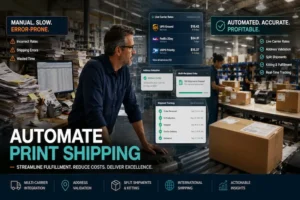

In 20 Seconds: Why Campus Print Teams Need Web-to-Print
- University print centers are under pressure. More short-run work, more customization requests, more departments ordering independently, and more compliance requirements – all with flat or shrinking staff. Web-to-print is not about replacing people. It’s about removing friction so skilled operators can focus on production instead of chasing emails and fixing preventable errors.
- The bottleneck isn’t your equipment – it’s your intake process. Most campus print shops already have capable digital presses and finishing equipment. What’s holding them back is order intake chaos: email threads, walk-in requests, missing specs, and manual approvals that eat up hours every day.
- Automation protects your team, not replaces it. Structured ordering, standardized templates, and automated approvals eliminate the administrative touches that cause burnout and production delays. The result is better throughput, fewer errors, and more breathing room for your operators.
- Key Benefits: Elimination of email-based ordering, brand compliance across all departments, automated budget controls and approvals, support for decentralized and hybrid campuses, reduced rework and production errors, higher utilization of existing hardware, and a stronger strategic position for the print center.
The Reality of Running a Campus Print Shop in 2026
If you manage a university print center, you already know the daily reality: a steady stream of email requests with missing specs, walk-in customers who need something “right now,” phone calls asking for status updates on jobs you haven’t even received files for, and a growing backlog of work that never seems to shrink – even though your team is working harder than ever.
The demands on campus print operations have changed dramatically. Digital printing has made short runs economical, which means more jobs flowing through the shop. Departments expect faster turnaround. Marketing needs brand-compliant materials across dozens of units. And administration wants tighter budget controls and better reporting. All of this lands on the same team, with the same equipment and the same headcount.
This isn’t a technology problem. It’s a workflow problem. And it’s one that web-to-print was specifically designed to solve.
This article explores how modern web-to-print platforms are transforming higher education print operations – not by adding complexity, but by removing the friction that turns a skilled production team into a group of email-chasing, error-correcting, order-entry clerks. The goal is operational relief: giving print teams control, consistency, and room to do what they do best.
Note: If you’re looking for a deep dive on brand consistency challenges specifically, check out our article on how universities lose brand consistency without centralized print systems. And for a closer look at how private storefronts work in an educational setting, see Private Storefronts: The Future of Print for Educational Institutions. This article focuses on the operational transformation and how web-to-print makes life better for the people running the print center.
Doing More With the Same Campus Print Team
Universities are not expanding their print teams. In many cases, they’re asking existing staff to absorb more work as departments consolidate and budgets tighten. That pressure is real, and it’s not going away.
The answer isn’t working harder. It’s eliminating the low-value administrative touches that consume production capacity. Consider how much of your team’s day is spent on activities that have nothing to do with actual printing:
Activity | Time Spent (Typical) | Value Added |
Answering emails to clarify job specs | 2-3 hours/day | None – this should be captured at order entry |
Re-keying order details into the MIS | 1-2 hours/day | None – this is duplicate data entry |
Tracking down approvals and budget codes | 1-2 hours/day | None – this should be automated |
Fielding “where’s my order?” calls | 30-60 min/day | None – customers should self-serve |
Correcting files that arrived production-unready | 1-2 hours/day | None – specs should be enforced upfront |
A web-to-print platform eliminates most of these touches by structuring the ordering process itself. When jobs arrive with complete specs, validated budget codes, approved artwork, and production-ready files, your team can focus on what they were hired to do: produce excellent print.
The story here isn’t about headcount reduction. It’s about protecting the team you have from the administrative overload that causes burnout, overtime, and turnover. When operators aren’t interrupted every ten minutes to answer a question that should have been answered at order entry, throughput improves naturally.
Eliminating Email Orders and Walk-In Chaos
The single biggest source of inefficiency in most campus print shops is unstructured order intake. When jobs come in through email, phone calls, walk-in requests, or – worst of all – handwritten notes left on the counter, every order becomes a mini-project: interpreting what the customer wants, following up for missing information, and manually entering the details into the production system.
This is where a web-to-print storefront fundamentally changes the dynamic.
From Unstructured to Production-Ready
A well-configured storefront replaces open-ended email requests with guided product builders that capture every required detail at the point of order:
- Paper stock, size, quantity, and finishing are selected from predefined options – no guessing, no “I’ll figure it out later.”
- Required fields ensure that nothing critical is missing before the order can be submitted.
- File upload requirements enforce correct formats, resolutions, and bleed specifications.
- Real-time pricing gives the customer an instant quote, eliminating the back-and-forth quoting cycle.
- Online proofing lets the customer preview and approve their job before it enters production.
The result is that every job arrives at the production queue complete, validated, and ready to print. The clarification emails stop. The phone calls drop. The walk-in interruptions decrease. And operators can plan their day around a clean, structured job queue instead of reacting to whatever lands in the inbox next.
Standardizing Brand Compliance Across Departments
Universities are inherently decentralized. Dozens of colleges, departments, research centers, student organizations, and administrative units all create and order printed materials – often independently and with varying degrees of brand awareness. The result is a campus littered with logo variations, color mismatches, and off-brand materials.
For the print center, this creates a lose-lose situation. Either you become the brand police – reviewing every job, rejecting non-compliant artwork, and dealing with frustrated customers – or you print what comes in and let marketing deal with the fallout.
Web-to-print eliminates this tension with a simple principle: make compliance the path of least resistance.
Locked templates with approved logos, colors, fonts, and layouts give departments the flexibility to customize content (names, dates, event details) while preventing them from modifying the elements that define the brand. The print center becomes a brand steward rather than a cleanup station. Marketing retains control without becoming a bottleneck. And departments get professional, on-brand materials without needing a graphic designer on staff.
This approach also eliminates one of the most common sources of reprints: materials that were produced correctly according to what was submitted, but didn’t meet brand standards. When the template enforces the standard, the error simply can’t happen.
Automating Approvals and Budget Controls
Departmental budgets, cost center codes, and approval chains are a necessary part of university operations – but in a manual workflow, they’re a constant source of friction. Print staff end up chasing approvals, verifying budget codes, and playing gatekeeper for spending policies that aren’t theirs to enforce.
A web-to-print platform automates these controls entirely:
- Budget validation happens at checkout. If a department has exceeded its allocation, the system blocks the order before it ever reaches the print shop. No awkward phone calls. No after-the-fact billing disputes.
- Approval routing is configured by rules – job type, spend threshold, department, content sensitivity. Orders that need approval are automatically routed to the right person with email notifications and reminders. Orders that don’t need approval flow straight to production.
- Cost center tracking is captured at the point of order, not reconciled after the fact. Every job is tagged with a valid budget code before it enters the queue.
- Reporting gives administrators real-time visibility into who’s ordering what, how much they’re spending, and where the budget stands – without the print shop having to compile anything manually. Automated reports allow you to “set and forget” these reports, ensuring fail-safe delivery.
The print center’s role shifts from manual gatekeeper to automated workflow manager. Compliance happens by design, not by policing.
Supporting Decentralized and Hybrid Campuses
The traditional model of a single campus print shop serving a single physical campus is increasingly outdated. Universities today operate across satellite locations, extension centers, and hybrid environments where faculty and staff work remotely. Print needs don’t disappear just because people aren’t on the main campus.
A centralized web-to-print portal makes ordering consistent regardless of location. A faculty member at a satellite campus 50 miles away has the same access to the same product catalog, the same templates, and the same approval workflows as someone in the office next door to the print shop. Jobs can route to the correct production center automatically based on location, product type, or capacity. Shipping automation handles delivery logistics for remote locations with real-time carrier rates and address validation.
Built-in budget codes and reporting features simplify cross-campus coordination, giving administrators a unified view of print activity across the entire institution – not just the main campus.
Reducing Rework and Production Errors
Every reprint is a double cost: you pay for the wasted materials and press time on the original run, and you pay again to produce the corrected version. In a campus print environment, reprints typically stem from a small set of recurring causes:
- Incorrect specs submitted by the customer (wrong size, wrong stock, wrong quantity)
- Artwork files that aren’t print-ready (low resolution, wrong color space, missing bleeds)
- Outdated content that should have been reviewed before printing
- Miscommunication between the customer and the print shop about what was actually ordered
A structured web-to-print storefront prevents most of these errors at the point of order. Intelligent product configuration limits customers to valid combinations of specs. File validation catches common artwork problems before submission. Locked templates ensure that brand elements and standard content are always current. And online proofing provides a clear, visual confirmation of exactly what will be produced.
When intake is structured, production becomes predictable. Less interruption means better morale and better throughput – and far fewer of those frustrating conversations that start with “this isn’t what I ordered.”
Maximizing Existing Hardware Investments
Most university print centers have made significant investments in capable digital presses, wide-format printers, and finishing equipment. The hardware isn’t the problem. The problem is that the equipment sits idle or underutilized because the order pipeline is unpredictable and inefficient.
Web-to-print improves hardware utilization in several practical ways:
- Better batching. When jobs arrive in a structured, digital queue with complete specs, it’s easier to batch similar jobs together – grouping by stock, size, or finishing requirement to minimize makereadies and maximize press efficiency.
- Queue visibility. Operators can see what’s coming and plan their day accordingly, rather than reacting to whatever walks through the door.
- Scheduling discipline. With clear turnaround times set in the system and automated notifications, rush jobs become the exception rather than the norm. This allows for more efficient scheduling and less overtime.
- Reduced downtime. When fewer jobs need to be stopped, corrected, and rerun, press uptime improves naturally.
The result is higher utilization of equipment you’ve already paid for – without buying more hardware or hiring more staff. That’s a conversation every print manager wants to have with their administration.
Elevating the Print Center’s Strategic Role
Here’s the shift that matters most in the long run: when ordering is easy, consistent, and transparent, the print center stops being perceived as a reactive order-taker and starts being recognized as a strategic campus partner.
Web-to-print enables this shift in several concrete ways:
- Reporting and analytics provide visibility into usage trends, departmental demand, seasonal patterns, and cost-per-piece metrics. This data helps print managers justify budgets, plan capacity, and make the case for strategic investments.
- Stakeholder engagement increases because ordering is frictionless. When departments can get what they need quickly and reliably, they use the print center more – and earlier in their planning process.
- Value demonstration becomes tangible. Instead of anecdotal evidence, you can show administration exactly how much work the print center handles, how much money it saves compared to outsourcing, and how it contributes to brand consistency and compliance.
- Strategic conversations become possible. When you’re not buried in administrative tasks, you have time to consult with departments on their upcoming needs, suggest new products and services, and position the print center as a resource rather than a cost center.
This is the transformation that PageDNA’s education-focused platform is designed to support: moving the print center from operational survival mode to strategic campus partnership.
Key Takeaways
- University print centers are under increasing pressure to handle more work with the same team. Web-to-print addresses this by eliminating low-value administrative touches, not by reducing headcount.
- The biggest operational gains come from structured order intake: replacing email chains, phone calls, and walk-in requests with guided, validated, production-ready orders.
- Brand compliance, budget controls, and approval workflows should be automated by design – not enforced through manual policing by print staff.
- A centralized portal supports decentralized and hybrid campuses, making ordering consistent regardless of location.
- Higher utilization of existing equipment is achieved through better batching, queue visibility, and scheduling discipline – not more hardware.
- The ultimate benefit is strategic: transforming the print center from a reactive cost center into a recognized campus partner.
Frequently Asked Questions (FAQs)
Will web-to-print replace jobs in our print center?
No. Web-to-print automates the administrative overhead – email management, order entry, approval chasing, and status inquiries – that prevents your team from doing production work. The goal is to protect your team from overload, not to reduce it. Most print centers find that their existing staff can handle significantly more volume with less stress once the workflow is automated.
Our departments are used to emailing orders. How do we get them to switch?
Adoption is a real challenge, and it’s one that PageDNA plans for from day one. The key is making the storefront easier and faster than email. When a department head can place a fully configured, brand-compliant order in three minutes instead of writing an email and waiting two days for a quote, the value sells itself. A phased rollout starting with willing departments, combined with clear communication about the benefits, builds momentum quickly.
We already have capable presses. Will web-to-print actually make a difference?
If your equipment is capable but underutilized because jobs arrive incomplete, get stuck in approval limbo, or require constant rework, then yes – the difference is significant. Web-to-print doesn’t improve the hardware; it improves the pipeline feeding the hardware. Better intake means better batching, fewer interruptions, and higher utilization of what you already own.
How does this work for satellite campuses and remote staff?
The portal is accessible from anywhere with an internet connection, and it can be configured to route jobs to the appropriate production center based on location or product type. Remote staff order through the same interface, see the same templates, and follow the same approval workflows as on-campus users. Shipping to remote locations is handled with automated carrier integration and real-time rates.
How does web-to-print help us demonstrate value to university administration?
This is one of the most underrated benefits. A web-to-print platform with robust reporting gives you hard data on order volume, turnaround times, cost savings, departmental spending, and equipment utilization. Instead of anecdotal arguments for budget or staffing, you can present clear metrics that demonstrate the print center’s contribution to the institution.
Conclusion: Operational Relief, Not More Complexity
The campus print shop in 2026 doesn’t need another piece of software to manage. It needs a system that removes the daily friction that turns a skilled production team into an overtaxed help desk.
Web-to-print, implemented well, delivers exactly that. It structures the intake process so jobs arrive complete. It automates the approvals and budget controls that shouldn’t require human intervention. It enforces brand standards without making the print shop the brand police. And it generates the data that elevates the print center from a cost line on a spreadsheet to a strategic asset that administration can see and measure.
If your team is spending more time managing emails than managing presses, it’s time for a conversation. Reach out to PageDNA at sales@PageDNA.com to see how our education-focused platform can give your print center the operational breathing room it deserves.
Related Posts: