
Originally published November 7, 2023 • Updated March 23, 2026
In 20 seconds: The Future of Web-to-Print in 2026
- The landscape has evolved. While core challenges like e-commerce and smaller job sizes remain, the new frontier is defined by AI, hyper-automation, and sustainability. Print shops that fail to adapt to these new realities will be left behind.
- AI is the new force multiplier. Artificial intelligence is moving beyond a buzzword and into practical application, automating everything from prepress checks and personalized recommendations to intelligent job routing.
- Sustainability is non-negotiable. Customers are demanding eco-friendly options, from recycled paper stocks to carbon-neutral shipping. Sustainability is no longer a “nice to have”; it’s a core business requirement.
- Automation is getting smarter. The focus is shifting from simple task automation to end-to-end workflow orchestration, connecting disparate systems and eliminating manual touchpoints entirely. This includes the rise of headless commerce and sophisticated API integrations.
- Key Trends for 2026: The rise of AI, sustainability as a standard, hyper-automation, the demand for headless and API-first solutions, the strategic importance of bulk ordering, enhanced security, data-driven decision making, hyper-personalization, and the continued challenge of smaller, more frequent orders.
Beyond the Basics: The New Era of Web-to-Print
Just a few years ago, the conversation around web-to-print trends was focused on the fundamental shift to e-commerce, the challenge of smaller job sizes, and the need for basic personalization. While these pillars remain crucial, the ground has shifted. The leading print shops of 2026 are not just offering online ordering; they are building intelligent, automated, and sustainable print ecosystems.
The landscape is no longer defined by simply having a digital storefront. It’s defined by the intelligence that powers it. Artificial intelligence, deep API integrations, and a relentless focus on workflow automation are separating the leaders from the laggards. Furthermore, as the world becomes more environmentally conscious, sustainability has transformed from a marketing buzzword into a critical business imperative.
This refreshed guide for 2026 will explore the nine most important trends shaping the future of web-to-print. We’ll revisit the foundational trends that continue to matter and dive deep into the new forces—AI, sustainability, and hyper-automation—that are defining the next generation of print.
Foundational Trends, Evolved
These are the core trends that have shaped the industry and continue to be critical for success, but with a 2026 twist.
1. E-commerce Is Table Stakes, Experience Is the Differentiator
In 2023, having an online ordering portal was the trend. In 2026, it’s the bare minimum. The focus has shifted from simply offering e-commerce to providing a seamless, intuitive, and personalized user experience. Customers now expect the same level of sophistication from their B2B print provider as they get from Amazon. This means mobile-responsive designs, easy reordering, and a frictionless checkout process.
2. Smaller, More Frequent Orders are the Norm
The trend of smaller, more customized orders has only accelerated. Digital printing technology has made it economical to order 50 of something instead of 5,000. For print shops, this means that efficiency is everything. The only way to remain profitable is to automate the intake, manufacturing, and fulfillment of these small jobs. A robust web-to-print software is the only way to manage this high-volume, low-margin reality without drowning in administrative work.
3. Hyper-Personalization at Scale
We’ve moved beyond simply putting a name on a business card. Customers now expect deep personalization integrated directly into the ordering process. PageDNA’s multi-tenancy capabilities are a perfect example of this, allowing each client to have a unique, branded storefront with their own products, pricing, and approval rules. In 2026, this extends to AI-driven product recommendations and dynamically generated templates based on user behavior.
The New Frontier: Trends Defining 2026 and Beyond
These are the trends that represent the most significant shift in the web-to-print landscape. They are not just incremental improvements; they are transformative forces.
4. The Rise of Practical AI
Artificial intelligence is finally moving from hype to practical application in the print industry. AI is being used to:
- Automate Prepress: AI-powered tools can automatically check artwork for common issues like low-resolution images, incorrect color profiles, or missing fonts. Companies like Fiery and Enfocus are leading this charge with intelligent preflight automation, reducing the need for manual prepress checks. OEMs have their own suite of powerful tools as well, such as Konica Minolta’s Flux, and HP’s PrintOS.
- Provide Intelligent Recommendations: AI can analyze a user’s order history and suggest related products or reorder reminders.
- Optimize Production: AI algorithms can analyze job queues and automatically route jobs to the most efficient press or finishing equipment based on size, stock, and deadline.
5. Sustainability as a Standard
In 2026, a commitment to sustainability is no longer optional. Customers, especially large enterprise clients, are increasingly making purchasing decisions based on the environmental impact of their suppliers. Print shops must respond by:
- Offering Sustainable Materials: Providing a wide range of recycled, FSC-certified, and alternative paper stocks.
- Implementing Eco-Friendly Practices: Using vegetable-based inks, reducing water consumption, and minimizing waste.
- Providing Carbon-Neutral Shipping Options: Partnering with carriers to offer customers the option to offset the carbon footprint of their deliveries.
Sustainability Initiative | Impact on Print Shop | Customer Benefit |
|---|---|---|
Recycled Paper Options | Requires sourcing and inventory management | Meets corporate social responsibility (CSR) goals |
Vegetable-Based Inks | Reduces VOC emissions, safer for employees | Non-toxic, easier to de-ink for recycling |
Carbon-Neutral Shipping | Integration with carrier offset programs | Aligns with customer values, provides a green choice |
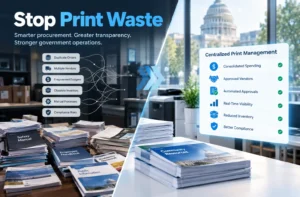
Web to print also ensures the most efficient use of hardware for internal print shops. For example, by centralizing and automating school-district print procurement and workflows, districts can cut redundant printing and untracked orders—reducing paper, ink, transportation, and overall waste as part of their Green initiatives.
6. Headless Commerce and API-First Integrations
As businesses build more complex digital ecosystems, they need their web-to-print platform to be a flexible, integrated component, not a siloed island. This has led to the rise of headless commerce.
- What is it? A headless architecture separates the front-end presentation layer (the “head,” or what the user sees) from the back-end e-commerce engine. This allows a company to use a best-in-class web-to-print engine like PageDNA to power the ordering logic, while maintaining complete creative control over the user interface, which could be a custom website, a mobile app, or even an internal procurement system.
- Why it matters: It allows for ultimate flexibility and integration. A company can embed a print ordering experience directly into their existing applications, creating a seamless user journey. This is powered by a robust, well-documented web-to-print API.
7. The Strategic Importance of Bulk Ordering
As explored in our deep-dive on the topic, the limitations of the traditional shopping cart have become a major pain point for enterprise clients. The ability to place hundreds or thousands of unique, personalized orders through a single spreadsheet upload—bulk ordering—has become a critical competitive differentiator. Print shops that can offer a true bulk ordering solution are winning large contracts for franchise rollouts, HR onboarding, and retail logistics.
8. Enhanced Security and Data Privacy
This trend continues to intensify. With the rise of data privacy regulations like GDPR and CCPA, and the constant threat of cyberattacks, security is a top concern for all businesses. A web-to-print platform must provide enterprise-grade security, including:
- Strong Access Controls (MFA + Role-Based Permissions): Multi-factor authentication (MFA) should be standard, with role-based access so users only see and do what they’re authorized to do. If your environment requires it, SSO can be an important capability to centralize identity and access management.
Network Protection and Firewalls (External + Internal Segmentation): A secure W2P environment should be protected by perimeter firewalls and also designed with internal controls that limit lateral movement—so a problem in one area can’t easily spread to others. Security is not only about “the cloud”; it’s also about how access is controlled across internal systems and networks. - Endpoint Security and Employee Device Monitoring: Many real-world incidents start with compromised credentials or a compromised laptop. The platform’s security posture should be supported by endpoint controls such as managed device policies, patching, malware protection/EDR, and monitoring that helps detect unusual activity—especially on employee devices that can access administrative tools or customer data.
- Encryption and Secure Data Handling: Data should be protected in transit (TLS) and, where appropriate, at rest, along with secure key management and careful handling of sensitive files (artwork, mailing lists, order data).
- Ongoing Security Practices (Testing + Accountability): Regular vulnerability scanning, penetration testing, security reviews, and an incident response process help keep defenses current. Some organizations formalize this with internal security leadership or external security advisors (including a virtual CISO) to maintain consistent oversight.
Gut feelings are no longer enough. Successful print shops are using data to make informed decisions about everything from pricing and product offerings to staffing and equipment purchases. A modern web-to-print platform with a powerful Reporting Feature provides the raw data needed to understand order trends, customer behavior, and production bottlenecks.
Key Takeaways
- The web-to-print landscape of 2026 is defined by intelligence, automation, and sustainability.
- AI is moving from a buzzword to a practical tool for automating prepress, personalizing user experiences, and optimizing production.
- A demonstrable commitment to sustainable practices is now a requirement for winning and retaining major clients.
- API-first and headless architectures are providing unprecedented flexibility for integrating print ordering into broader business ecosystems.
- Mastering the complexities of smaller, more frequent, and highly personalized orders through automation remains the core challenge and opportunity for profitability.
Frequently Asked Questions (FAQs)
How can a smaller print shop afford to invest in AI and advanced automation?
AI is affordable – some tools are even free. Learn from your partner. By partnering with a web-to-print provider that applies AI behind the scenes today—and is actively evolving its automation roadmap. Customers benefit through faster implementations, quicker support resolution, stronger documentation, and smoother processes driven by AI-assisted internal workflows.
Is “headless commerce” too complex for a typical print shop?
While the implementation of a fully headless solution is typically driven by the client’s IT department, the print shop’s role is to provide a platform with a powerful and well-documented API. The print shop doesn’t need to be a team of developers; they need to be a strategic partner with a flexible and capable technology platform.
Our customers aren’t asking for sustainable options. Should we still invest in them?
Yes. The demand for sustainability is growing rapidly, and it’s often a requirement in RFPs from large corporations, universities, and government agencies. The Sustainable Green Printing Partnership provides certifications that can help print shops demonstrate their commitment. By proactively offering sustainable options, you position your shop as a forward-thinking leader and open the door to new, larger opportunities.
Conclusion: Adapt or Be Left Behind
The pace of change in the web-to-print industry is accelerating. The trends that are shaping 2026 are not on the distant horizon; they are here now, and they are already creating a gap between the print shops that are adapting and those that are falling behind. The future of print is not just digital; it’s intelligent, connected, and sustainable.
By embracing these trends and partnering with a technology provider that is at the forefront of innovation, you can ensure that your print shop not only survives but thrives in the exciting and dynamic years to come.
Related Posts: